
A breakdown of the discoverability shift every author needs to know about, translated from Social Media Marketing World 2026.
Estimated read time: 9 minutes Category: Book Marketing / Social Media for Authors Author: Raewyn Sangari
Picture your ideal reader.
She’s curled up on that giant comfy chair with her tea. She’s got soft lo-fi music in the background, desperately trying to unwind. She’s between books and looking for her next one.
She’s not searching Goodreads. She’s not browsing the Amazon bestseller list. She’s not even on her Kindle Unlimited dashboard.
She’s on TikTok. And within thirty seconds of opening the app, she’s already searching for her next read.
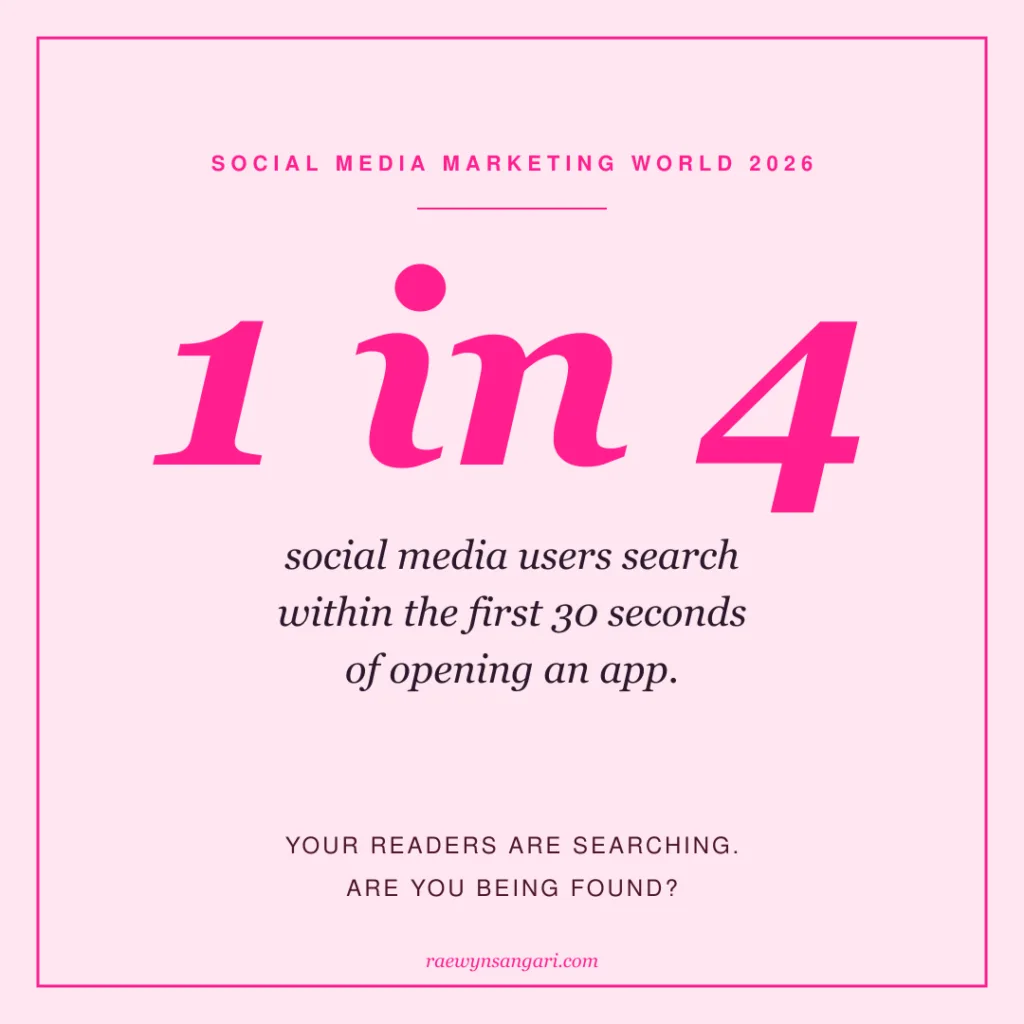
This isn’t speculation. According to the experts at Social Media Marketing World 2026, 1 in 4 social media users now searches within the first thirty seconds of opening an app. Google Search is dropping. Social discovery is rising. And the way readers find authors has fundamentally changed.
The old rule of marketing was know, like, trust.
The new rule of book discovery is find, remember, trust.
That differentiation is everything.
What Actually Changed
For years, the conventional wisdom for authors was: build a website, grow an email list, post on social media, and eventually readers would find you. The journey was slow but the path was clear.
That path is gone.
Google Search traffic is dropping across the publishing industry. Readers are no longer typing “books like Off Campus” into a search bar. (And when they are searching the old fashioned way, the first results they see are AI generated.)
They’re opening Instagram or TikTok and watching a video where someone explains exactly how Elle Kennedy’s books go deeper than the Prime TV show. They’re scrolling Instagram and seeing a carousel of hockey romance recommendations. They’re on Threads live posting their reactions to the show.
This is what the marketing world calls social discovery. And it’s now the dominant way new content (including new books) gets found.
A few numbers from SMMW 2026 that stopped me in my tracks:
- 1 in 4 users search within the first 30 seconds of opening an app
- 50% of Instagram is now Reels and video content
- 200+ billion Reels are watched daily
- Active social discovery (TikTok, Instagram) is now outpacing passive discovery (the feed)
Your reader isn’t going to Google to find her next book. She’s scrolling. She’s searching in-app. She’s discovering through social proof from people whose taste she trusts.
And the question becomes: when she searches, can she find you?
The Trust Matrix: From Know-Like-Trust to Find-Remember-Trust
Judi Fox, a LinkedIn strategist whose session at SMMW absolutely shifted my thinking, has named the framework I’ve been circling for months.
The reader journey used to look like this:
Know → Like → Trust → Buy
The reader stumbled across you from the algorithm, decided you seemed likeable, developed trust over time, and eventually bought your book.
In 2026, the journey looks like this:
Find → Remember → Trust → Buy
The reader has to be able to find you first. She has to remember you across multiple touchpoints. And then she trusts you. The order is different. The work is different.
You can’t be trusted before you’re found.
The other day I described it like this for indie authors: traditionally published authors or well-known authors are able to rely on NYT Bestseller lists for their readers. Indie authors have to give the readers a reason to REMEMBER them and relate to them. We’ll talk more about how your bio can build the “Remember” part, but for now we are breaking down the “FIND.”
Find: Be Discoverable
This is the new starting line. If your content isn’t optimized to be found (through search keywords, hashtags, on-screen text, platform-native SEO, and GEO), the rest of the journey never starts.
For authors, this means your bio, your captions, your on-screen video text, and your post topics need to mirror the way your readers actually search. Genre keywords. Trope names. Comp-author tags. The specific words your dream reader is typing into TikTok and Instagram search bars.
**It is absolutely important for me to note that the old ways of keyword stuffing on your images is absolutely unnecessary. The algorithms can read the on-image texts, closed captioning, and any content you put in the caption. You don’t even need hashtags for discoverability anymore. So don’t sit there putting a whole bunch of gibberish or keywords at the bottom of your social media captions because that’s going to hurt your trust.
Remember: Be Memorable
Once you’re found, you have to stick. Reader memory is built through consistency, not virality. They need to recognize your writing style, character descriptions and YOU. This is where relateability in your bio and posts come into play. If they connect with you over your favorite drink (or your character’s…hello Ari Lancaster’s Pumpkin Cream Chai) or the way your dog photobombs every book photo, they’re going to remember you.
Beyond your relateability, your reader should be able to predict the feel of your content before she even taps.
Trust: Be Credible
Trust now comes from behind-the-scenes content, vulnerability, real conversations in DMs and comments, and the consistency of showing up over time.
The polished launch photo gets the like. The messy writing-day post gets the comment.
Why This Is Actually Good News for Authors
I’m going to say the quiet part out loud. This shift is good for authors. Specifically, it’s good for indie authors, hybrid authors, and the women in publishing who’ve felt locked out of the algorithm for years. (Adam Mosseri himself just said that Instagram is anyone’s game based on content and not follower numbers.)
The algorithm is content-driven, not follower-driven. Every author has a chance to be discovered now, not just established names with big platforms. A debut author with 200 followers and a compelling Reel can reach more readers than a celebrity author with 200,000 followers and a generic post.
AI is eroding trust in polished content. Readers are getting better at sensing what’s generic, AI-generated, or formulaic. Now more than ever YOU are a competitive advantage, even as the quirky book nerd who didn’t talk to anybody in high school. If you’re purchasing content packs and templates, AI prompts and the like, you’re falling flat. (I can’t believe I just said that. RIP all of the content packs I was creating circa Spring 2023 and never published. RIP my old AI prompts freebie opt-in. Hello VISUAL HOOKS!)
Smaller, engaged accounts are outperforming large, passive ones. The platforms reward content that gets watched, saved, shared, and commented on. None of those metrics require a huge following.
This is the best moment in years for an indie or hybrid author with a story and a voice to be discovered.
You just have to know what to do with it.
What Does This Look Like in Practice?
Big-brand marketers will tell you to optimize for discoverability with budget, ads, and a content team. My indie author friends and I don’t have those things.
For Find: Use the Words Your Readers Search
- Your Instagram bio should include genre keywords readers actually search (think: “cozy fantasy author,” “domestic suspense,” “second-chance romance”). Want my eyes on your bio? Comment on this Instagram.
- Your on-screen Reel text should match search behavior, not internal book lingo
- Your captions should use hashtags that match how readers describe their favorite books, not how the industry describes them
- Pin posts that include your strongest discoverability signals
For Remember: Build Content Buckets That Reinforce Your Themes
- Pick three to five core content buckets and rotate them consistently with a GOAL for each one: community, conversation, discovery, conversion, etc).
- Use a distinctive visual element so your content is recognizable in a scroll (At SMMW they talked a lot about how movement at the start of the clip stops the scroll, and I can honestly say that my last 3 reels confirmed that.)
- Repeat your themes across formats: a photo carousel today, a Reel tomorrow, a Story next week, all reinforcing the same world or the same topic. Stop thinking that people are going to get tired of the same thing, chances are they aren’t actually seeing or registering it more than once.
- Your reader should think “oh, this is HER” before she sees your name
For Trust: Show Your Process
- Behind-the-scenes posts about your writing process build more trust than polished cover reveals
- Real conversations in DMs and comments (even short ones) build relationship faster than perfectly crafted captions. Try out INSTANTS to do this, too! (My thoughts on Instants)
- Vulnerability earns trust faster than expertise
- Consistency over time beats frequency and perfection all day every day. If you can only post once a week and show up to engage 3 times a week, set yourself up for that INSTEAD of trying to do a daily thing.
Glimmer Effect Homework: Try This Today
Pull up your last five posts. Score each one against these three questions:
1. The Find Test Could a stranger searching your genre find this post? (Keywords in caption, on-screen text, hashtags, alt text)
2. The Remember Test Does this post sound like you? Would a reader recognize it as yours without seeing your name? (Voice, theme, visual signature)
3. The Trust Test Does this post help a stranger believe you’re real? (Behind-the-scenes, specificity, vulnerability, your actual face or voice)
If you can answer yes to all three on a post, that post is doing its job.
If you can’t, you have your next content roadmap.
What’s Coming Next
This is just the start of the conversation. Over the next ten weeks, I’m walking through exactly what I learned at Social Media Marketing World 2026, translated for the way authors actually work. We’re covering:
- The most underrated piece of your author marketing (your bio)
- How to find content that genuinely sounds like you
- The honest truth about analytics for creative-brain authors
- What I’m learning publicly on Threads and Substack
- And the framework that’s been quietly emerging from all of it
If you want this kind of translation delivered to your inbox every week, you can join the list below. I plan to send one email a week, and listen to my own advice on consistency. Every single one is built for authors who want to show up online without losing themselves in the process.
Just because advice exists doesn’t mean it’s for you. You have to find the framework that fits the way you write, share, and connect or you’ve lost the social part of social media.
Additional Resources of Discoverability for Authors
Because I’m a girls’ girl, here are a few of my favorite resources I’ve been consuming outside of what I learned at SMMW.
- Full Social Media Marketing World Breakdown blog post on Women in Publishing
- AI Is Now a Book Discovery Engine—and Many Authors Are Invisible In It – Substack Article by Alexa Bigwarfe
- What Is GEO for Authors? Learn how AI Is Changing Book Discovery – deeper dive into GEO by Alexa Bigwarfe (If you prefer to listen, here’s her podcast episode about it).
- The Social Media Shift That’s Changing Everything – podcast & Youtube from Jasmine Star
Raewyn Sangari is a book marketing strategist, social media educator, and the Creative Director of the Women in Publishing Summit. She translates big-brand marketing strategy for authors who want to show up online without losing themselves in the process.